

People form first impressions remarkably fast: in one well-known study, judgements of trustworthiness, likeability and competence made after seeing a face for just a tenth of a second closely matched judgements made with no time limit. Your expression is part of that split-second read, and how you feel about your smile shapes how freely you use it.
Most of those judgements happen before a single word is spoken. This guide looks at what we know about smiles and first impressions, and why feeling good about your smile matters as much for how you see yourself as for how others see you.
How fast do people form first impressions?
Very fast. In 2006, Princeton researchers Janine Willis and Alexander Todorov showed people photos of unfamiliar faces for just 100 milliseconds. Their judgements of attractiveness, likeability, trustworthiness, competence and aggressiveness were already closely in line with judgements made with no time limit, and longer viewing mainly made people more confident in the impression they had already formed.
Facial expression is part of that split-second read, and a smile signals openness and warmth. You don't need to be told this by a study: think how differently you react to someone who greets you with a smile.
The science behind smile perception
Smiles are contagious
When someone smiles at you, it is natural to smile back. That shared moment creates a quick sense of connection, which is why a natural smile changes how an interaction feels for both people.
Teeth are part of how we read a smile
When you smile openly, your teeth are on show. Their colour is one of the things people notice, which is why stains from coffee, tea, red wine or smoking can make some people hold back from smiling fully.
How you feel about your smile shows in how you act
When people feel self-conscious about their smile, they often compensate: covering their mouth when they laugh, avoiding wide smiles in photos, holding back when they meet someone new. These adjustments are small, but they add up, and they can affect how relaxed and engaged a person comes across.
First impressions in professional settings
Smile confidence matters at work too: in job interviews, client meetings, presentations and networking. A relaxed, natural smile signals ease and self-assurance, qualities most employers and clients look for, and a forced or hidden smile is harder to read.
The compound effect: smile confidence does not just affect single interactions. People who feel good about their smile tend to smile more often, which makes interactions easier, which builds confidence. It is a cycle that can run in either direction.
The social media dimension
Profile pictures, video calls and photo sharing are part of everyday life, so how you look when you smile now carries weight in places it never used to: a LinkedIn headshot, a dating profile, a group photo shared with friends.
For many people, photos and video are a more frequent source of smile self-consciousness than meeting in person. At-home whitening is a practical, affordable way to address that one specific concern.
Does smiling change how you feel?
A little, yes. The facial feedback hypothesis suggests that the act of smiling can nudge how you feel. A 2019 review of 138 studies in Psychological Bulletin found the effect is real but small, and varies between situations.
The bigger effect is often indirect. When people feel confident about their smile, they use it more freely, and spend less energy monitoring themselves in social situations. In other words, improving how you feel about your smile doesn't just change how others see you. It changes how you carry yourself.
Why small changes have an outsized impact
You don't need a perfect smile to feel more confident about it. Often a modest change, a few shades brighter and a cleaner look, is enough to stop you thinking about your smile and simply smile.
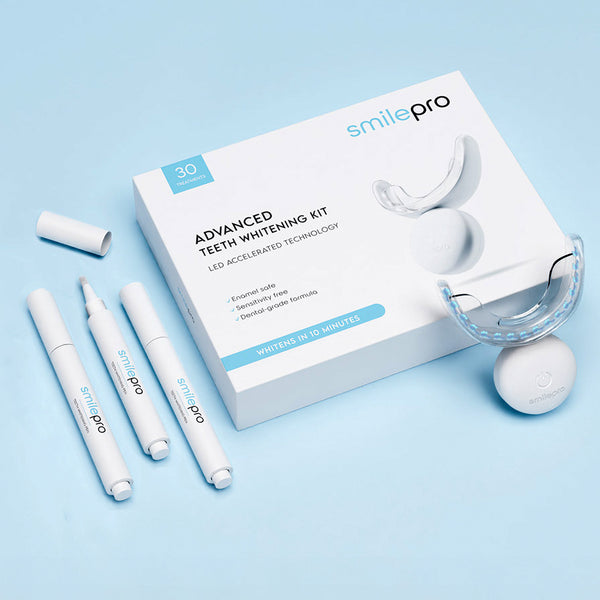
The threshold isn't perfection. It's feeling comfortable enough to smile without thinking about it. With the SmilePro Advanced Kit, most customers see a noticeable difference after the first treatment, and the full 7-day course whitens teeth up to 8 shades.
Ready to feel more confident in your smile? Explore SmilePro →
What this means for you
Understanding the psychology of a smile reframes teeth whitening. It's not a vanity exercise; it's about feeling comfortable in your own smile. How you feel about your smile influences how you present yourself, which shapes how others respond to you.
The good news is that a brighter smile is more accessible than most people realise. You don't need in-chair treatment at the dentist: the SmilePro Advanced Teeth Whitening Kit takes 10 minutes a day for 7 days, then a 10-minute top-up every 2 weeks. The gel is always used with the light, and the kit comes with a 30-day money-back guarantee (conditions apply). After each treatment, wait 1 hour before eating or drinking anything except water.
SmilePro whitening products are not suitable for anyone under 18, or anyone pregnant or breastfeeding. If you have sensitive teeth or unhealthy gums, see a dentist first.
Shop the SmilePro Advanced Teeth Whitening Kit →
Related: Confidence and your smile, why small changes make a big difference →
Related reading:
Sources
- Willis J. and Todorov A., First impressions: making up your mind after a 100-ms exposure to a face, Psychological Science, 2006, 17(7):592-598.
- Coles N. A., Larsen J. T. and Lench H. C., A meta-analysis of the facial feedback literature: effects of facial feedback on emotional experience are small and variable, Psychological Bulletin, 2019, 145(6):610-651.
- SmilePro product information: Advanced Teeth Whitening Kit and our Terms and Conditions.
Last updated: 7 October 2026.




Lämna en kommentar
Denna webbplats är skyddad av hCaptcha och hCaptchas integritetspolicy . Användarvillkor gäller.